
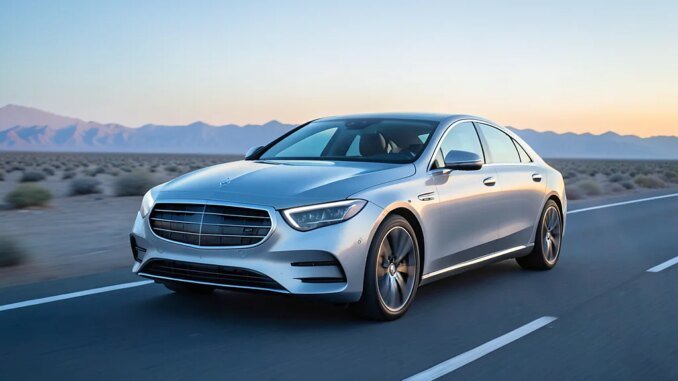
The updated 2026 Mercedes EQS 450+ covered 867 km on a single charge in Edmunds’ real-world range test, surpassing the previous record held by the Lucid Air Dream Edition. The result makes the Mercedes a new benchmark for long-distance range among tested luxury electric cars.
How far did the Mercedes EQS 450+ travel?
The EQS 450+ completed 867 km in Edmunds’ test. That is more than the 800 km achieved by the Lucid Air Dream Edition, which had previously held the real-world range record. Test results can vary with driving speed, weather, road conditions, and vehicle configuration, so everyday range may differ.
What changes improved the EQS’s range?
The updated model pairs a 122 kWh battery with several efficiency-focused engineering changes. Mercedes increased capacity by 4 kWh from the previous 118 kWh pack, a rise of roughly 3%. The larger battery contributes to the result, but drivetrain and electrical-system improvements also help the car use its energy more efficiently.
A two-speed transmission on the rear engine helps the drivetrain operate effectively across different driving conditions. The EQS also uses an 800-volt electrical architecture and a revised battery-anode design that combines silicon oxide with graphite. Together, these changes help explain how the car achieved a reported 16% range increase despite the relatively small battery-capacity boost.
How quickly can the EQS 450+ charge?
Edmunds reported an average charging rate of 222 kW during the cited charging performance. At that rate, the EQS can add about 161 km of range in approximately seven minutes under suitable conditions. Actual charging times depend on factors such as charger output, battery temperature, and the vehicle’s state of charge.
Mercedes EQS 450+ range and charging at a glance
Real-world test range: 867 km
Battery capacity: 122 kWh, up from 118 kWh
Reported average charging rate: 222 kW
Range added in about seven minutes: approximately 161 km
The EQS 450+’s record-setting test result combines a modest battery increase with changes to its drivetrain, electrical architecture, and battery technology. Its reported charging performance also adds practical appeal for drivers making long journeys, though real-world results will depend on conditions and charging equipment.




Be the first to comment