
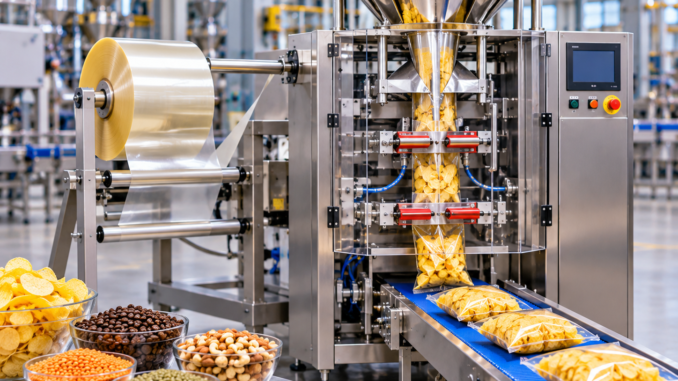
Walk down the snack, coffee or pulses aisle of any supermarket and most of the pillow-shaped bags you see were made on the same type of equipment. A vertical form fill seal machine takes a flat roll of film, turns it into a bag, fills it with a measured amount of product and seals it, all in one continuous cycle. Because it does so much in a small footprint, the VFFS machine has become one of the most common packaging systems in food production. This article explains how it works, step by step.
The Basic Idea
The name describes the process. The machine forms a bag from film, fills it while the bag hangs vertically, and seals it at the top and bottom. Gravity does much of the work: product drops from a weighing or dosing unit above, through a tube, and into the bag forming below. Since the bag is made on the spot from roll stock, there is no need to buy and store pre-made pouches, which lowers packaging costs.
Main Components
A typical vertical form fill seal machine is built around these parts. The exact layout varies by supplier, but the functions stay the same on every VFFS machine:
- Film unwind and tensioning unit: holds the film roll and keeps tension steady as the film is pulled through.
- Forming shoulder (collar): shapes the flat film into a tube.
- Forming tube: the product falls through it into the bag.
- Vertical (back) sealer: seals the overlapping edges of the film to close the tube lengthwise.
- Pull belts: draw the film down by exactly one bag length per cycle.
- Horizontal sealing jaws and knife: create the top and bottom seals and cut the finished bag.
- Dosing system: a multihead weigher, volumetric cups, or an auger filler, depending on the product.
- Control panel (HMI): where operators set bag length, speed, temperature and recipes.
Step-by-Step Operation
1. Film Feeding
On a vertical form fill seal machine, the film roll sits at the back or side of the frame. It passes over rollers that keep it flat and correctly tensioned. If a printed film is used, a photo-eye reads registration marks so each bag is cut at the right point and the logo always appears in the same place.
2. Forming the Tube
The film travels over the forming shoulder, which folds it around the forming tube. The two edges overlap or meet, and the vertical sealer applies heat and pressure to join them. The result is a continuous film tube.
3. Sealing the Bottom
The horizontal jaws close across the tube to make a seal. This seal becomes the bottom of the bag being filled and the top of the bag below it.
4. Dosing and Filling
The dosing unit releases a measured portion of product, which drops through the forming tube into the open bag. Granules such as rice or nuts are often weighed by a multihead weigher. Powders like flour or milk powder are dosed by an auger. Some lines flush the bag with nitrogen at this stage to extend shelf life.
5. Top Seal and Cut
The pull belts move the film down by one bag length. The jaws close again, sealing the top of the filled bag. A knife inside the jaws separates it from the tube, and the finished pack drops onto the outfeed conveyor.
The whole cycle repeats continuously. Depending on the product and bag size, a VFFS machine can produce from around 30 to well over 100 bags per minute.
Intermittent vs. Continuous Motion
In an intermittent machine, the film stops while the jaws seal. This design is simple, and an intermittent VFFS machine suits a wide range of products. In a continuous-motion machine, the film never stops and the jaws move with it. That allows higher speeds, especially for light products such as snacks, which is why many snack producers run a continuous-motion vertical form fill seal machine. The right choice depends on target output and the product.
Bag Styles
Most lines produce pillow bags, but a vertical form fill seal machine can also be configured for gusseted bags, block-bottom bags, bags with hang holes, or bags with zippers. Changing between styles usually means changing the forming set and adjusting settings on the control panel. On a modern VFFS machine, this changeover can often be completed within an hour.
Why Manufacturers Choose This Design
Several practical reasons explain why the vertical form fill seal machine is so widely used. It packs a lot of function into a small floor area, runs on lower-cost roll stock, and adapts to powders, granules and solid items. A VFFS machine also integrates easily with checkweighers, metal detectors, date coders and case packers. For producers who need to scale up, a well-specified VFFS machine can grow with the business through new forming sets and recipes.
Conclusion
A vertical form fill seal machine forms a bag from film, fills it with an accurately dosed amount of product and seals it, all in one cycle. Understanding each stage, from film feeding to the final cut, makes it easier to compare suppliers and pick the right configuration. When evaluating a VFFS machine, ask for a trial run with your own product and film so you can judge speed, seal quality and weight accuracy before you buy. A good vertical form fill seal machine, matched to the product and properly maintained, can serve a production line reliably for many years.







Be the first to comment