
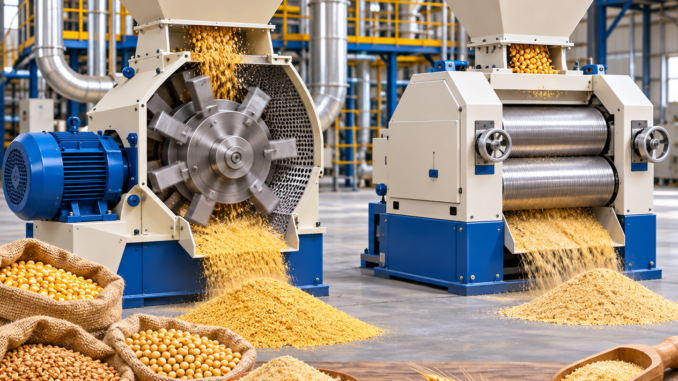
Grinding is one of the first and most energy-intensive steps in feed production. The two most common grinding systems are the hammer mill and the roller mill. Both reduce grains to a smaller particle size, but they work in different ways and suit different needs. In this article, we compare the two systems to help you choose the right one for your plant.
How does a hammer mill work?
Rows of fast-rotating hammers strike the grain and break it into small pieces. The ground material passes through a screen around the rotor, and the hole size of the screen determines the final particle size. This design makes the hammer mill very flexible: it can grind corn, barley, wheat, soybean meal and many other raw materials.
Strengths
- Handles a wide range of raw materials
- Fine grinding is easy to achieve
- Particle size can be changed by switching screens
- Relatively low investment cost
How does a roller mill work?
Grain is crushed between pairs of rollers that turn at set speeds, and the gap between the rollers controls the particle size. Because the grain is crushed rather than shattered, a roller mill gives a more uniform particle size with less dust and fewer very fine particles. It also usually uses less energy per tonne, especially for coarse grinding.
Strengths
- Uniform particle size
- Less dust and fines
- Lower energy use for coarse grinding
- Quieter operation
Which system gives better feed quality?
It depends on the animal and the feed form. For pelleted poultry, pig and aqua feeds that need fine grinding, a hammer mill is usually the better choice. For ruminant and some poultry feeds where a coarser, more uniform structure is preferred, a roller mill gives excellent results. Uniform particles also mix better and are less likely to separate after mixing.
Energy, maintenance and operating costs
Energy use rises sharply as grinding becomes finer, and this is where the hammer mill consumes more power. On the other hand, its hammers and screens are simple and inexpensive to replace. Rollers need periodic re-corrugation or replacement, but they wear slowly when kept well adjusted. Comparing the energy cost per tonne for your own formulas is the most reliable way to judge running costs.
Maintenance points
- Hammer and screen wear
- Roller gap adjustment
- Roller re-corrugation interval
- Bearing and drive checks
Can you use both systems?
Many modern plants combine the two. A roller mill can pre-crush grain before final grinding, or the plant can run separate lines for fine and coarse products. This approach gives the flexibility to produce many feed types with good quality and controlled energy use.
Questions to answer before deciding
- Which animal species do you produce feed for?
- What particle size do your formulas require?
- Will most of your feed be pelleted or mash?
- What is your energy cost per tonne?
There is no single best grinding system for every plant. A hammer mill offers flexibility and fine grinding, while a roller mill offers uniform particles and lower energy use for coarse products. By defining your product range and capacity first, you can choose the system, or the combination, that fits your feed mill best. An experienced supplier can help you test both the hammer mill and the roller mill with your own raw materials before you invest.







Be the first to comment