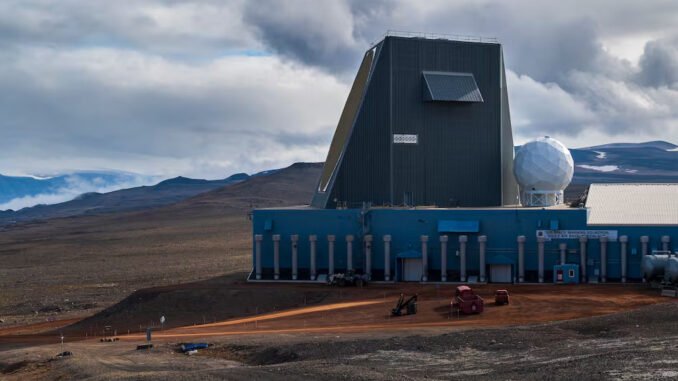
Greenland’s early warning radars, which have been North America’s first line of defence against ballistic missile attacks since the Cold War, are vulnerable to new and rapidly evolving threats. With the advent of hypersonic missile technology, US bases in Greenland can neither detect nor effectively intercept attacks at Mach 5 and above, experts say. This calls for a fundamental rethinking of Arctic security strategies.
Existing Systems Cannot Respond to the New Threat
Troy Bouffard, Director of the Arctic Security and Resilience Centre at the University of Alaska, pointed out that the US does not have an integrated air and missile defence launcher layer based in Greenland. Bouffard said that the new and future threat posed by hypersonic cruise missiles had changed everything due to the inadequacy of existing defence systems.
In their article for the Small Wars Journal, Bouffard and his colleagues advocated the establishment of a comprehensive air and missile defence system, particularly for Pituffik Spaceport, where missile and space defence sensors are located. The fact that Pituffik is currently guarded by troops focused on ground defence against commando or terrorist attacks suggests that it is not capable of intercepting hypersonic attacks.
Layered Defence and New Technologies Proposal
Experts propose a “layered air defence using short- and medium-range systems adapted to Arctic operations” as part of a broader defence system distributed across the North American Arctic. This layered system could include Patriot batteries, NASAMS (National Advanced Surface-to-Air Missile Systems) and SHORAD (short-range air defence) systems.
According to the article, this defence architecture requires the integration of various sensors: Ballistic missile radars, Air defence radars against low-altitude threats, Airborne early warning aircraft or over-the-horizon radars, Layered Laser Defence (LLD) systemsconsidered as future tactical solutions
Challenging Climate and Multiple Command Complexity
However, the inherent difficulty of Arctic operations makes it difficult to install and maintain these systems. In an environment where temperatures can drop to minus 100 degrees Celsius, factors such as ice, snow and extreme cold can significantly affect the performance of radar and visual sensors. The article emphasised that technologies such as adaptive optics and polarimetric radar can mitigate these effects, but success requires Arctic tactical warfare capabilities and expertise.
The defence of Greenland presents geographical and political challenges. Greenland, an autonomous region of Denmark, is positioned as both an American and a European/NATO issue. Under US President Donald Trump, the US’s desire to buy the island did not satisfy both Greenlanders and Danes.
Strategic Transformation: Greenland Part of US Internal Defence
Having until recently assigned Greenland to the US European Command (EUCOM), the Pentagon made a critical decision in June to transfer responsibility for the island to the US Northern Command (NORTHCOM). This transfer is a clear sign that Greenland is now seen as an integral part of US internal defence.
The defence of Greenland requires close cooperation between multiple commands, including not only NORTHCOM, but also North American Air Defence Command (NORAD), EUCOM and US Strategic Command (STRATCOM), the article said. This multi-command oversight will ensure that the defence effort is no longer isolated, but part of a comprehensive Arctic operational plan that is compatible with US homeland defence and NATO collective defence.
The authors concluded that successful defence would require a refocusing of resources on the Arctic, not as an afterthought, as has been the case since the end of the Cold War, but with forethought, attention and planning.